
What Developers & EPCs Now Need From Battery Suppliers in the FEOC Era
The February 2026 IRS guidance gave the market its first real look at how “material assistance” will be measured—and what the IRS will actually expect to see in terms of documentation around battery storage equipment.
Battery procurement is no longer just about price, delivery timelines, quality and performance. It’s now a compliance and documentation exercise–and a decision about how to approach sourcing in a shifting environment.
Developers and EPCs are now asking a more fundamental question:
While incentives will continue to be enticing, it’s not the only option. In some cases, sourcing from established, lower-cost supply chains and not relying on tax credits can still produce strong project economics. We break this down in more detail here.
So today, procurement isn’t just about how to comply—it’s about deciding whether compliance is the right strategy to begin with. The reality is EPCs and developers aren’t needing to just buy batteries anymore; they’re navigating a moving regulatory landscape, evolving supply chains, and financing constraints.
And that requires more than a vendor. It requires the right partner.
ITC Eligibility—or Not—Is Now a Core Procurement Decision
The latest IRS guidance forces a decision:
Do you design your procurement strategy around ITC eligibility, or around cost and supply chain efficiency?
Compliance depends on where components are sourced, how costs are allocated, and whether you can prove it. For battery storage, that’s not trivial. A system may include cells, modules, inverters, and materials sourced across multiple jurisdictions.
Which means:
Pursuing ITC eligibility requires structured sourcing and documentation
Not pursuing ITC opens up a broader, often lower-cost supply base
There is no one-size-fits-all answer. The right path depends on your capital stack, risk tolerance, and target project economics.
What Developers Actually Need From Battery Suppliers – If You Select FEOC Compliance
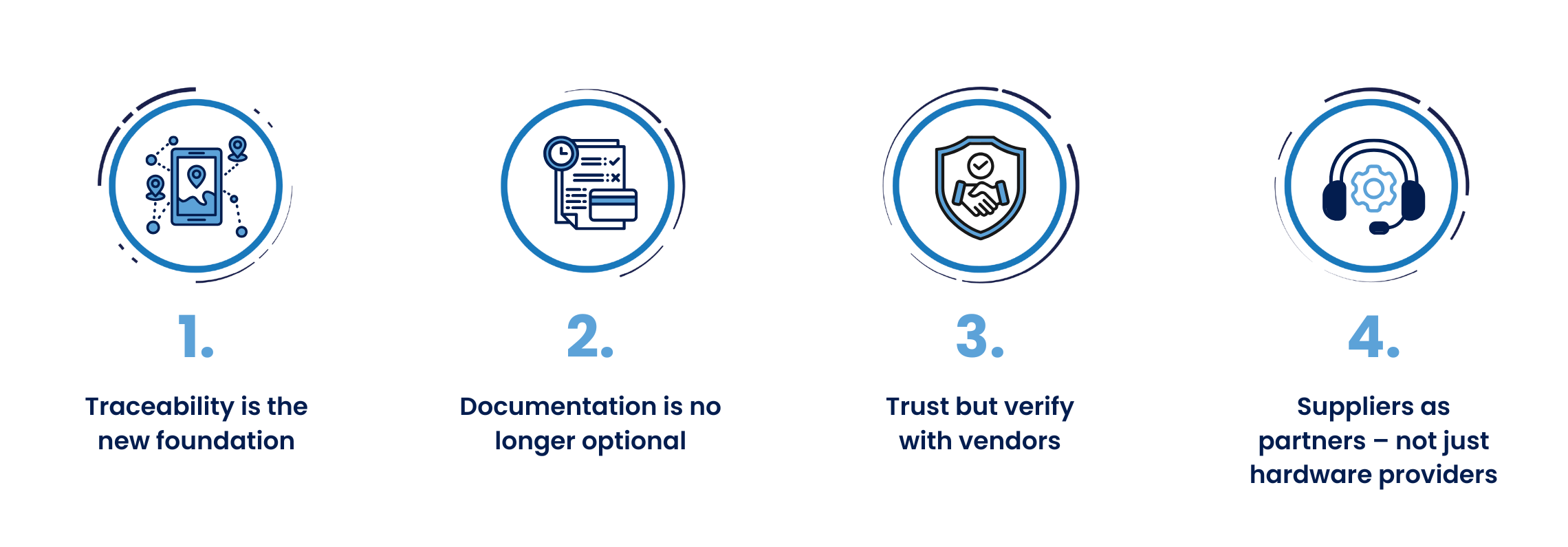
It starts with traceability
Developers now need real visibility into where their batteries are coming from—not just at the system level, but down to cells, materials, and upstream ownership. Even if the system integrator is compliant, upstream exposure can still affect how a project is evaluated.
Documentation is no longer optional
This is where the February guidance gets very real. Projects now need structured, audit-ready documentation—not just for diligence, but to support material assistance calculations (MACR).
That typically includes:
Bill of materials with origin tracking
Cost breakdowns by component (cell, module, PCS, etc.)
Identification of which components are PFE-linked
Assigned or calculated cost percentages for each component
Supplier certifications and supporting evidence
The IRS framework effectively requires developers to demonstrate what portion of total system cost is attributable to PFE-related inputs. This becomes especially critical in mixed sourcing scenarios—specifically with integrating Chinese battery cells with non-Chinese balance-of-system components. In those cases, developers must quantify exposure using cost ratios—not just make qualitative claims.
This is a shift from “who supplied it?” to “what percentage of the system does it represent?”
“Trust but verify” is the new standard
The IRS allows reliance on supplier certifications—but that doesn’t eliminate risk. Developers still need to stand behind those claims if challenged. That means you need to start compiling formal certifications and supporting documentation around claims, along with contractual accountability.
Suppliers are expected to support outcomes—not just deliver hardware
Battery suppliers are now being pulled into conversations that go well beyond equipment. Procurement decisions are now tied directly to financial outcomes—and suppliers are expected to engage at that level, but not always equipped. As such, finding a strategic partner with deep BESS expertise and understanding of how best to navigate this landscape is essential.
The Right Partner Matters
All of this complexity raises a practical question:
Who is actually helping you navigate this?
Most EPC and renewable developer procurement teams weren’t built to manage multi-layered supply chain verification and investor-driven, government-mandated documentation requirements. This is where procurement specialists are becoming much more than just equipment-based intermediaries.
They can help developers:
Evaluate if FEOC compliance is the right economic decision based on your project
Support in gathering and reviewing supplier claims for compliance / risk assessment
Align procurement with financing realities while keeping projects on schedule
In today’s environment, the difference between a supplier and a partner is meaningful.
Not All Projects Will Take the Same Approach
There isn’t just one viable path forward in the FEOC era. Projects backed by institutional capital—especially those relying on tax equity—will often prioritize compliance and documentation above all else. But that’s not the only strategy.
A growing number of developers are evaluating projects that do not rely on tax credits at all, instead sourcing from established supply chains and underwriting based on core project economics. In many cases, this can still produce strong returns—particularly when paired with thoughtful project structuring. We explore this further here.
The Takeaway:
The “right” procurement strategy depends on your capital, your timeline, and your risk tolerance—not just the policy environment.
The good news is that supply is evolving. Manufacturers are adapting, transparency is improving, and new FEOC-aligned options are coming online—though timelines and availability still vary quite a bit.
At GridVest, we’re working across Tier 1 suppliers—both with FEOC compliance and non-compliance—to help developers evaluate these options.
We expect additional FEOC-aligned supply to become available later this year and into early 2027.
The Bottom Line
Battery procurement has fundamentally changed.
With these changes, supplier timelines are increasingly uncertain—and often outside of their direct control. Plus new battery systems may carry performance and bankability risk due to limited deployment history. This means developers need to look beyond promises—and focus on what can actually be delivered, documented, and financed–with or without ITC and FEOC compliance.
In the FEOC era, success isn’t just about sourcing batteries. It’s about choosing the right strategy — and the right partner — to get your project across the finish line.
If you’re evaluating whether FEOC compliance is the right path for your project, get in touch with GridVest—we can help you navigate the tradeoffs and determine the best strategy for your specific economics and timeline.
