
Navigating BESS Equipment Selection
A practical framework for evaluating BESS equipment. Spec sheets tend to read alike, but total cost of ownership rarely does.
Spec sheets all read well. Every supplier claims proven performance, competitive pricing, and reliable after-sale support. So how do you actually tell the difference, and make the best decision for your C&I battery storage project?
For EPCs and developers evaluating BESS equipment today, the challenge isn't a shortage of options — it's making a high-stakes decision with complex, incomplete information and under time pressure. And the single most common mistake we see? Optimizing for upfront cost instead of total cost of ownership. The gap between those two numbers is where projects tend to underperform.
What GridVest has found time and time again, a financial model is only as good as the technical assumptions underneath it.
Between tariff volatility, evolving FEOC rules, and shifting fire codes, the evaluation process now carries more weight than it did even two years ago. Get it wrong, and you're not just leaving money on the table, you're carrying the consequences through the full project lifecycle.
The Shift That Changes Everything
There's a useful comparison between how developers evaluated solar equipment in the PV-only era versus how BESS needs to be evaluated today.
From roughly 2010 to 2020, PV procurement was relatively straightforward: lowest installed $/W was the dominant metric. Degradation was predictable, warranties were comparable, and the asset was largely passive once commissioned.
Storage changed the math. Battery prices have fallen roughly 40% in the last three years, and in markets like CAISO under NEM 3.0 and ERCOT, storage has moved from optional to essential. But a battery isn't a passive generator — it's an active asset that has to be optimized, not just installed. Performance depends on how the system is actually used: cycling frequency, depth of discharge, thermal management, and EMS configuration can all make or break a project.
The success metric isn't the lowest day-zero cost. It's the lowest lifetime cost of energy — dollars per kWh delivered over the life of the project.
That distinction matters more than most buyers realize early in the process. A $50/kWh savings on cells can become a $200/kWh loss when you account for equipment failure, associated downtime, financing complications, and fire code issues from an unproven supplier.
“A single non-warrantable service ticket can run $2-4k in labor alone not counting lost revenue and crew opportunity cost due to system downtime. Multiply that across several visits a year and substandard equipment adds up fast.”
The Most Common Mistake
Most procurement decisions are still anchored to CapEx. Which is understandable given that “day-zero” cost is visible, comparable, and easy to defend internally. Lifecycle cost is harder to model and easier to defer until after a project has already been commissioned.
The trouble is that a financial model is only as honest as its inputs. Tools to model can expose 50-plus parameters, and it's easy to accept the defaults — even when the defaults don't match your project. The real risk lives in the details that never show up in a quote.
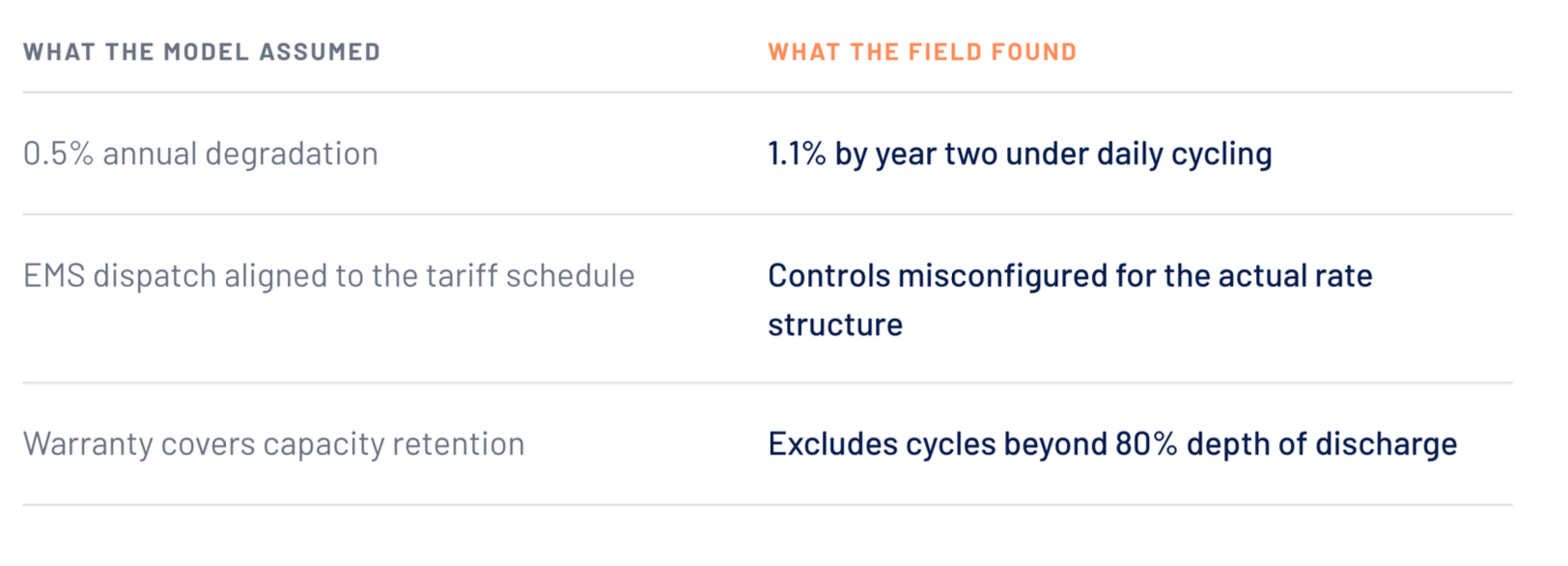
None of these are edge cases. They're common enough that the gap between what a financial model assumes and what a project actually delivers has become one of the more consistent sources of project underperformance we see in the field.
Avoiding low-cost equipment is not the only answer, but rather evaluating equipment against the right criteria early on in a project, and before the purchase order.
A Framework for Evaluation
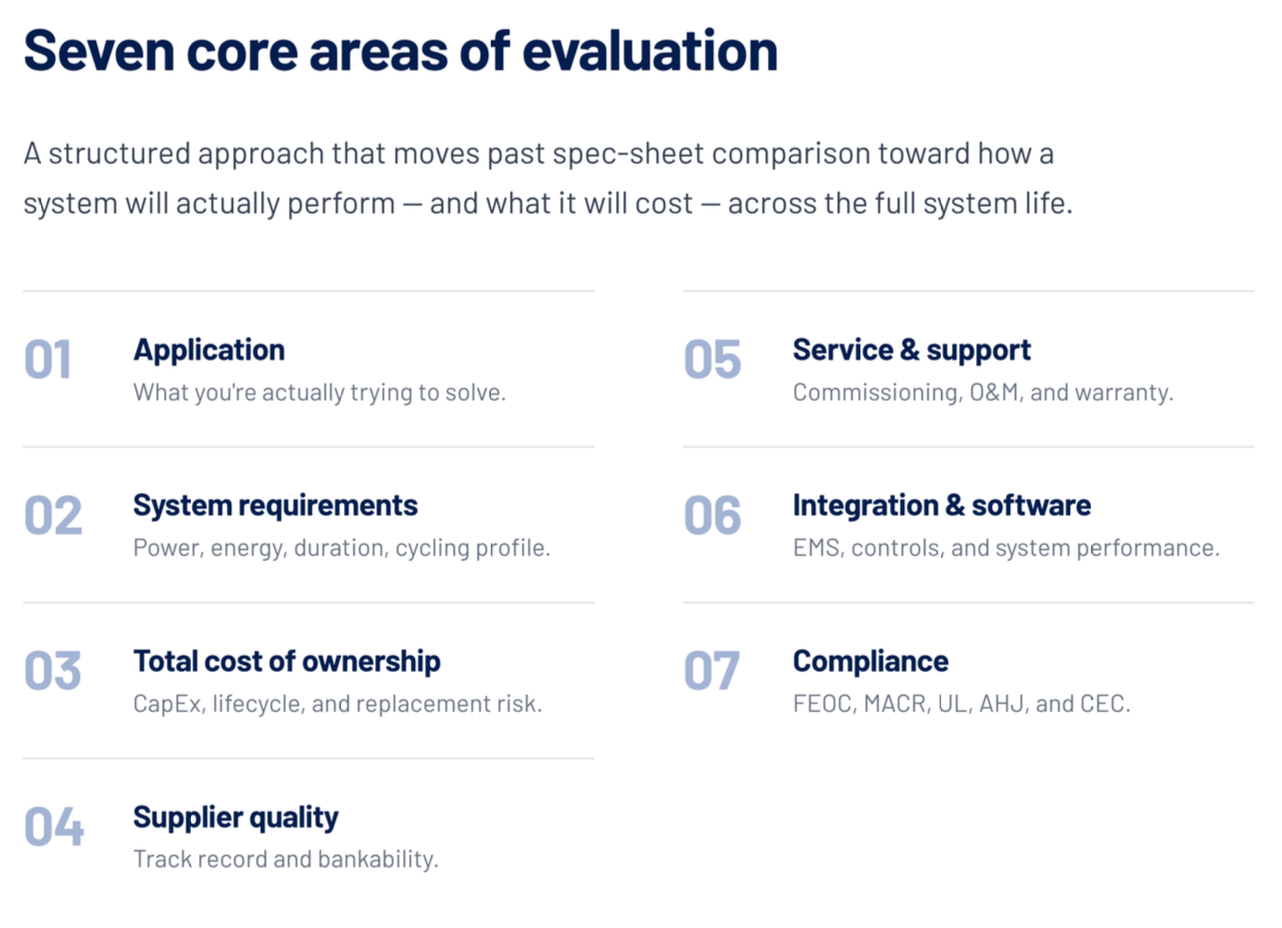
At GridVest, we've developed a structured approach to BESS equipment selection built around seven core areas. The goal is to move beyond spec-sheet comparison toward a more complete picture of how a system will actually perform — and what it will cost — across the full system life.
The starting point is always the same question: what is the system actually trying to accomplish? Most projects fall into two broad buckets — ROI-driven storage (TOU arbitrage, demand-charge management, demand response and VPP revenue, EV-charging support) or resiliency and backup (critical-load protection, islanding, off-grid or weak-grid sites).
But that’s not where the evaluation stops. These are the 7 key areas GridVest uses to evaluate BESS equipment-project fit.

The Areas Most Often Underweighted
If we had to pick the three areas where evaluation tends to be shallowest, they'd be total cost of ownership (TCO) miscalculations, EMS, and FEOC framing.
Total cost of ownership: buyers pay close attention to CapEx and often underestimate what happens at the back end. End-of-warranty battery replacement is frequently the largest hidden liability in a project finance model. Understanding what a warranty actually covers is work that needs to happen before a purchase order, not after a problem arises.
EMS: the brand name on the hardware enclosure gets more attention than the controls stack inside. Who built the EMS, what is the support path if something fails, and how well does it actually model dispatch for your specific operating profile?
FEOC: the compliance question is real and should be taken seriously. But treating FEOC status as the primary selection filter — rather than modeling both paths (FEOC-compliant + ITC versus non-FEOC with lower upfront cost) and running sensitivity analysis on the premium — often leads to suboptimal decisions. Run the numbers, then decide.
How to Put This Into Practice
The framework above is designed to be used — not just understood. We've put together a downloadable BESS Equipment Selection Framework that walks through each of the seven areas with the specific questions to ask suppliers, the red flags to watch for, and the tradeoffs to evaluate before committing to equipment.

For example, a recurring lesson across resiliency projects: if you don't define the application up front, you won't realize you need something like a third-party controller layered over a turnkey EMS to hit precise load-shed targets — and you'll discover it at a costly point in the project.
On urban C&I sites, the equivalent lesson is fire code: coordinate with the AHJ early and often, because maximum allowable quantities, setbacks, and hazard mitigation analysis can reshape where equipment goes and which products qualify.
Download the BESS Equipment Selection Framework by signing up below:
If you're in the early stages of a project and want a second set of eyes on your evaluation, we're happy to take a look. GridVest is vendor-agnostic by design — we work across manufacturers and don't carry a quota. Our job is to help you find the right system for the project, not the right project for a system.
